
How to Set an Intention in Yoga and Life
A Simple, Honest Guide
I’ll be straight with you: I didn’t always understand the point of “setting an intention.”
In my first yoga classes, the teacher would say “take a moment to set your intention,” and my mind? Blank.
I didn’t know why I needed one or how to choose it. It felt like everyone else knew some secret language that I was missing.
But as my practice unfolded, I started to feel what intention-setting actually does. Slowly, quietly, it began shaping the way I moved — not just on the mat, but in life.
So this post is a mix of personal experience and practical tools, in case you’re also trying to figure it out.
What Is an Intention in Yoga?
An intention is a quality you choose to cultivate — something you want to embody. It’s not a goal.
Goals point outward. Intentions point inward.
A goal says: “I want to do a handstand.”
An intention says: “I want to approach the challenge with patience.”
One creates pressure.
The other creates space.
When you set an intention at the beginning of your practice — or your day, or your season — you’re choosing the energy you want to move with. You’re placing a tiny anchor inside yourself. Something to return to when the mind gets loud or the body gets tired.
Why Setting an Intention Matters
Intention-setting shifts your experience in real ways:
It focuses your attention
Your mind stops spinning and chooses a direction.
It creates internal clarity
You know what you’re practising beyond the poses.
It builds momentum
Tiny daily choices start aligning with your inner values.
It cultivates positive energy
You show up from a place of purpose, not autopilot.
It’s not magic — but it can feel like it. But to prove it is not, let`s look at it from a scientific point of view. What does happen to our brain when we set the intention:
1. Focus reshapes your attention system
When you choose an intention, you activate the prefrontal cortex — the part of the brain responsible for focus, planning, and conscious direction. It’s like telling your mind, “This is what matters today.” Your attention starts filtering the world through that lens.
2. The brain’s “spotlight” begins searching for alignment
The Reticular Activating System (RAS) — your internal attention filter — kicks in. Once you set an intention, the RAS highlights anything related to it and quietly ignores what isn’t. That’s why gratitude intentions suddenly make you notice small good things.
3. Repetition strengthens neural pathways
Each time you return to your intention, you reinforce a network of neurons. This is neuroplasticity in action — your brain literally builds a pathway for the qualities you’re cultivating. Consistency turns intention into instinct.
4. Emotional alignment seals the learning
When your intention is tied to a feeling (calm, compassion, courage), the limbic system stores it more deeply. Emotions act like glue for memories and behavioural change.
5. Mind-body sync boosts embodiment
Breathing with the intention activates the parasympathetic nervous system, which calms your body and clears mental noise. This creates the perfect internal environment for your intention to take root.
How to Set an Intention: Step-by-Step
1. Reflect on what actually matters to you right now
Before you choose anything, pause. Notice what you’re carrying today: stress, softness, restlessness, hope — whatever’s alive in your body.
Ask yourself:
What do I need more of?
What do I want to cultivate?
What quality feels missing or calling?
This is about honesty, not perfection. Your intention comes from the truth of the moment, not from who you “should” be.
2. Keep it simple — one word is enough
The mind loves to complicate things, but intentions work best when they’re small and sharp.
A single word can shift everything: presence, clarity, courage, patience, trust.
Simple intentions are easier to remember and easier for your nervous system to hold during practice.
3. Make it personal, not performative
Your intention should resonate in your chest, not impress anyone.
Don’t pick something because it sounds spiritual or noble — pick something because it speaks to your current life.
The most powerful intentions are the ones you actually feel.
4. Let it guide your breath, your movement, your attitude
Once you choose your intention, let it become a quiet thread through the practice:
When the pose gets hard, return to it.
When the mind wanders, breathe it in.
When you soften or open, let it echo through that space.
Your intention isn’t just a thought — it’s a way of moving, breathing, being.
5. Check in afterwards — gently
At the end of practice, pause and notice:
Did anything shift?
Did the intention land in your body?
Did it feel true, or did you resist it?
There’s no right answer. The check-in is simply awareness, the same way you’d open a window to let light in.
6. Watch how your intention echoes into life
Intentions don’t end when you roll up your mat.
Over time, they sneak into your everyday moments — the way you talk, the way you choose, the way you react.
Notice if your intention shows up when you’re frustrated, tired, or lost. Those are the moments where the practice becomes real.
Examples of Simple Yoga Intentions
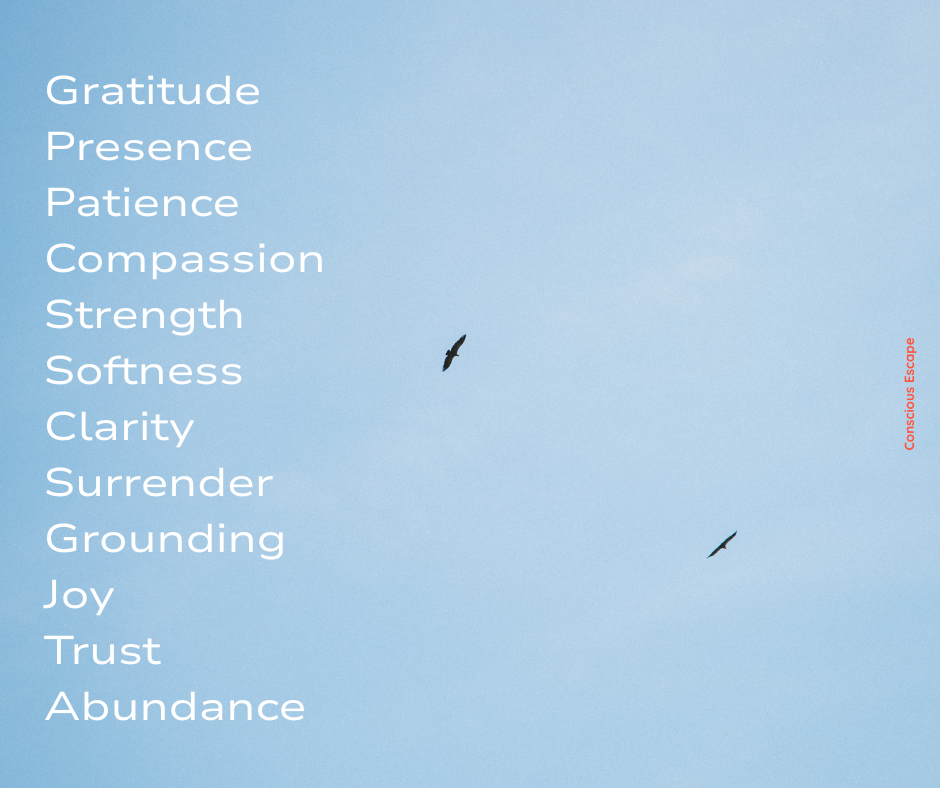
Examples of intentions you can set at the beginning of the yoga class
How to Use Your Intention During Class
Return to it when a pose challenges you
Pair it with your exhale
Let it shape your attitude, not your performance
Bring it back when the mind wanders
Seal it at the end with gratitude or reflection
Common Mistakes When Setting an Intention
Making it too big or too complicated
Treating it like a strict rule
Trying to force something emotional
Expecting immediate transformation
Intentions are whispers, not commands.
When You Don’t Know What Intention to Choose
Trust me, I know this moment too well.
Sometimes my mind wants to practice everything at once — gratitude, presence, calm, strength…
And I’m left staring at the mat like, “Girl, decide.”
If that happens, I choose abundance.
A reminder that my inner world is big enough to hold all of this.
That I can practice everything — just not all at once.
Thankfully, there are many practices ahead.
My Personal Experience with Intention-Setting
Have I noticed any changes in my day-to-day life or in my asana practice since I started setting intentions? Honestly… yes, a lot.
In those moments when I catch myself feeling confused, lost, or just frustrated with life, the one thing that reliably stabilises me is coming back to my intention.
If my intention for the day was gratitude, for example, I return to it the second I feel myself spiraling. I pause and ask:
“Okay… what’s one thing I can be grateful for right now?”
Just one. Nothing fancy.
And the thing is — there is always at least one thing.
Sometimes it’s tiny. Sometimes it’s almost silly. But it shifts something inside.
It’s like opening a small window in a stuffy room. You start breathing again.
And that’s enough. That one small thing carries you forward. You take it from there.
If You Want to Explore This Together?
You’re always welcome to join one of my classes or workshops, where we move through intention-setting in a more embodied, grounded way.
Check out my upcoming events — I’d love to practice with you.
